So yesterday, I happened to mention that I'm bummed not to get another Ramadan in Morocco. I know that might surprise some of you. Fasting all day isn't easy, and as it inches closer to the summer**, going without water (let alone food) all day will just get harder.
But I don't mind the sacrifice, and I do reeeeally love Ramadan's l-fdor food. L-fdor means "the breaking of the fast", aka "breakfast", and is the name for the morning meal, most of the year, and for the first meal eaten after the sunset call to prayer (aka l-Moghreb) during Ramadan.
L-fdor, during Ramadan, consists of olives, dates, aghrom n tadount (fatbread), harira (tomato and chickpea and lentil soup), milliwi (a sort of oily crepe, also known as lmsmn), fresh-squeezed orange juice, and peppermint tea. Plus lots of cookies. It's all delicious.
As Ama knows, my favorite part is the aghrom n tadount - literally bread of fat, commonly called fatbread by PCVs. I call it Moroccan pizza. Like a calzone, it's thick bread filled with deliciousness, in the form of herbs, minced vegetables, and tiny bits of sheep-fat that melt into the bread as it cooks. Mmmmm.
So yesterday, during our conversation, I mentioned that I'm going to have to find some Moroccan friends, and/or a Moroccan restaurant, and go there during Ramadan. 'Cause I'm gonna miss the food. :)
And then today, when I went up for lunch (an hour late, because I hadn't realized that Morocco has adopted Daylight Savings Time again this year - I thought they'd learned their lessons from the debacle of the past two years), Ama presented me with a giant loaf of fatbread. :D
Her kids had opted for her neighbor's couscous, so even though I was late, there was lots left for me. She and I both had a slice (you cut it into wedges, just like pizza), and then she urged another one on me...and who am I to say no to my Ama? :)
More munching, more playing with the baby, more hanging out with my brothers and sisters... I'm really going to miss these folks, and am just so grateful for every minute I get with them, in my final weeks.
** The lunar and solar calendars not aligning perfectly, the Muslim calendar shifts 11 days each year, with respect to the Gregorian calendar we all know and love. This means that my first Ramadan was the whole month of September (2008), my second was the end of August and most of September (2009), and this year it'll be most of the month of August. Could you go all of August without drinking water during daylight hours? In a country without air conditioning, where you work in the fields all day? Yeah, Ramadan is hard.
Here in the heart of Amazigh culture, weddings haven't changed too much in thousands of years. The clothes have gotten a little fancier, but the music and dancing and feasting feel as old as these hills.
As I've mentioned, my cousin "Lucky" has been engaged for months now. At least half a year; the first time I asked when the wedding would be, I was told, "Probably after Ramadan." Since I wouldn't have asked if Ramadan had already begun, I must have heard about the engagement sometime in July or August.
And they never set a date.
The wedding has been "soon" for six months. And then, two days ago, I walked home from the transit stand, past my aunt and uncle's house, and they grabbed me. My 3tti and cousin were sitting on their front stoop, as they often are, and they told me that the wedding would be today, Sunday. So this morning, I brought a cone of sugar and my best Berber clothes over to Ama's house, and prepared to play dress-up. She (gently, graciously) vetoed my choice of dress (tejlabbit) and earrings. I'd brought a dozen pairs of earrings, but didn't have any other fancy-dress clothes, so she dressed me up in one of her takshitas (caftans).
My little sister's dress (takshita) was even fancier, being made out of satin:
(Here, she's reading a comic book I'd brought her from Rabat. And yes, we got her to change out of her red turtleneck into one that matched the purple caftan.) I didn't ask why my little sister was so dressed up, but I must have looked a little puzzled, because Ama explained that the dress had been donated by a neighbor. A closer look revealed that it was a good six inches too long and five inches too wide, but a safety-pin across the back had pulled it tight enough to work. (The one-size-fits-all school of caftan design doesn't apply quite as well to little children, who come in a wider variety of sizes than adults.) She further explained that my little sis will get a custom-made, fitted, dress caftan of her own when her big sister gets married (whether that's me or our other sister, now 19 years old), but that for a cousin's wedding, a borrowed one will do.
The bride wore white, which isn't traditional but is becoming increasingly common, and was unveiled, which floored me:
(The other girl is Lucky's cousin, in her best golden-thread caftan/takshita.) Lucky's hair was pulled back in a gorgeous knot, pinned with flowered clips. Really, she could have worn the dress as a bride at the Plaza, and while it would have been clear she came from a different culture, she would have looked like a bride. (Well, I think so, but then, I've been here for 26 months. If I'm wrong, tell me.)
Note that both girls - like nearly every other female at the wedding - have their eyes rimmed intezolt, or kohl. They'd done their makeup before I got there, and I hadn't thought to talk to them about it in the days before (though in retrospect, I should have).
The feasting and dancing and merrymaking went on for hours...into the wee hours. I snuck out early, just after midnight. It helps that I live next door!
And then, in the morning, the 17-year-old bride and her 18-year-old groom - who she'd met for the first time the day before the wedding, despite having been engaged to him for over a year - were packed off to his town. A PCV buddy of mine lives in that town; I'll ask him to keep an eye out for her.
After hearing from my host dad just how much Ama had missed me, I fully intended to go over to their house for lunch. When lunch rolled around, though, I was in the middle of something, so placated my conscience by promising myself that I'd go over for teatime, around 4:30 or 5.
Instead, they came to me.
At 4:30, I heard a knock on the door.
I trotted down the stairs and found Ama. I started to invite her up, but she instead urged me to come out. My cousin Lucky is getting married tomorrow (which I knew*), so preparations have already begun. We went over to Lucky's house, where I was fed milk and tea (since they know I don't drink coffee) and sponge-bread and lmsmn (sort of naan-like crepe-y bread) and chatted with the women of my family. In addition to the full spread of my 3ttis (ie, all Baba's sisters-in-law), Baba's own 3ttis were there.
So they asked me the usual spread of questions - are you married? do you have children? when will you find a man? - and I gave the usual answers. (Not yet, not yet, as God wills.) Then someone brought up my impending departure. Yes, I'm leaving soon. Yes, the time is close. Yes, very close: about a month.
And then came the rapidfire attack:
"So will you get married when you go back to America?" an 3tti wanted to know.
"As God wills," I evaded. "When you get married, you need to invite Ama and Baba and all your 3ttis and friends to America to come to the wedding," 3tti Rqiya announced.
"If God wills," I dodged.
And then Ama stepped in. "I've told Kauthar that when she finds a man, she just has to bring him here. We'll throw her a wedding like Lucky will have tomorrow." She gestured to the decorations (mostly taHruyts) already in place for tomorrow's festivities.
This seemed to reassure the 3ttis. "Oh, so she will find a man in America," they told each other. Repeatedly.
They were addressing their remarks to each other, not to me, so I didn't respond.
"And you'll bring your man here?" they asked, seeking confirmation.
"As God wills."
"Oh, that's good." "We'll meet your man." "That's very good." Their voices overlapped each other, while I gave my heartiest, slightly pained smile.
By the way, this was all happening at the slightly slower-than-normal speed that the older women have learned they need to adopt if the foreign girl is going to understand them. Berberville's women are famous for their rapidfire delivery. Even my tutor and friend, an intelligent and educated women who grew up just over in Souqtown, has trouble understanding them when they're at full speed.
So they've learned to slow down if they want me to listen and respond. And I've learned that if they are speaking at full velocity, it means they don't want me to understand.
So when Ama rattled off a machine-gunned sentence, I knew it was for their benefit, not for mine. And once I'd heard the whole thing (and taken a second to process it), I understood why. She'd said, "And FYI, the man she brings back might be black. Just be warned."
The 3ttis burst out in a chorus of shock and indignation.
Ama reiterated her point, and I nodded confirmation. She and I haven't talked about this in months, maybe years, but at some point, race came up, and I said that yes, I might marry someone of color. She was surprised (though much less so - or at least less visibly - than any of these women), and I'd told her that my sister and I have both dated men of color, so yeah, anything's possible.
I rarely discuss race with Moroccans, because I know I'm probably not going to like what I hear. And while I can try to rationalize to myself that different cultures and different countries will of course have different attitudes, it's still hard for me to like anyone who's cheerfully racist. I have a Black Studies minor, for pete's sake. (Plus, yes, the cliche is true, lots of my closest friends are non-white. As are an ex or two.)
So I rapidly girded myself up for this battle, and smiled cheerfully at my 3ttis while they railed at me. I won't reproduce their comments, because it would only hurt some of my readers. Here's my response, interjected among their remarks: "Maybe someone white, maybe someone black. Only God knows. And no, 3tti, I *don't* have 'the good color'. Just ask Rebha, here, who called me a matisha [tomato] my whole first summer. I'm too white. It's better to have some color. Besides, it's all in God's hands."
Our conversation was abruptly interrupted by the news that my sister had just been hit by a car. After a flurry of panic, it quickly became clear that the car was going the routine 5 km/hr that our barely-paved roads require, and that while she was shaken up, she was completely unhurt. (Alhumdulillah.)
But the conversation never got back around to me and my future honeybun, for which I was grateful.
After another few minutes of assorted chatter, Ama and I said our goodbyes and then went to our separate homes. After making plans to go to the wedding, of course. :)
Oh, and why did I call this post Women's Hour? Because in the hour or hour-and-a-half I spent there, I didn't see a single man or boy. (Well, not counting my nine-month-old baby brother.) I knew that weddings themselves were fairly gender-segregated, but I hadn't realized that the preparations are, too.
* When I arrived home last night, I saw my 3tti Rebha sitting with my cousin Lucky (names changed) on their stoop. I greeted them, told them about my travels, etc. They promptly informed me that Lucky's wedding, which has been impending news for months now, is scheduled for Sunday. See, here in Berberville, when folks get engaged, they don't really "set a date". Instead, they just publicize their intent to marry, and then wait a while. I've never figured out exactly what they're waiting for, though I'm sure that saving up money for the wedding plays a role. (It's haram - forbidden - to borrow money, which means that nobody takes out loans for homebuying or weddings or anything else. You just wait till you have enough money. That's why nearly every house you see is in some state of ongoing construction - whenever a windfall comes in, they'll add a room/floor/throw pillows.) I've been asking for months when Lucky's wedding will be, and always get the answer, "Later, inshallah." Accordingly, every time I travel, I accept that she may well be married and gone before I get back. But luckily (hey!) enough, I'll be here for the wedding! Expect pictures tomorrow. :)
The second activity of Tree Day required rubber gloves, day-glo vests, big woven baskets, and giant smelly truck.
On Sunday, March 21st, the International Day of Trees, a few hundred people got together to plant about 400 trees. But that was only the beginning. After the trees were planted, watered, and protected with rock circles, we moved onto Phase 2: The SouqTown Clean-Up.
Everyone who wanted them was given rubber gloves, and then we began marching through the streets, clearing away trash as we went. Like beneficial locusts, we scoured the landscape, leaving nothing unsightly behind. Here, a boy gathers cigarette butts from the wall in front of a municipal building:
Once we'd gotten the trash off the ground, we dropped it into one of about a dozen baskets, being carried by kids like these:
The kids carried the basket until it got pretty full. Some even stayed excited about lugging litter:
(Those girls kept their huge smiles all day long!) Once a basket filled up, its carriers ran over to the garbage truck, which kept pace with the parade of litter locusts, and emptied it out:
The garbage truck inched through the town surrounded by children, like a cross between a parade float and a robotic Pied Piper. A few bolder kids (and the odd Peace Corps Volunteer) occasionally hopped aboard:
We walked through all the biggest streets of SouqTown, attracting attention and commentary, as well as picking up a few extra litter collectors. :)
When we reached the middle school, it was already an hour or two past lunchtime, so we called a break and everyone dispersed to their homes.
But they reassembled at the Youth Center that afternoon, for Part 3 of Tree Day...
Today, Muslims around the world are celebrating the birth of the Prophet Mohammed. In Arabic, the name of the holiday is 3id Milud. It translates approximately as Feast of the Birth, and is one of only 3 major religions holidays Muslims celebrate annually. (Morocco has lots of holidays, but most of the rest are secular, and usually nationalistic - ascension of the king to the throne, king's birthday, the day Morocco staked its claim over Western Sahara by marching hundreds of thousands of people in to occupy it/live there...holidays like that.) Most of those holidays are marked on the Western (Gregorian, solar) calendar, so they fall on the same day each year. Islamic holidays, though, are marked on the Islamic (lunar) calendar, so they shift about a week and a half each (solar) year. So last year's 3id Milud was March 5th and 6th (? as I recall), and the year before was I think March 21st(?).
In addition, Islamic holidays are determined by the observed phase of the moon, which builds in some uncertainty. How full the moon looks to astronomers in key places in each country, determines whether or not they celebrate the holiday the following day. So folks don't know until the week of, and sometimes not even till the day of, if it's a holiday. There's probably a point to be made about the impact that has had on the role of uncertainty in the local culture, but I'll let it go.
Enough background.
Today we celebrated!
This is the first 3id Milud I've actually gotten to celebrate as such. The one two years ago was during CBT/stage, and though I was with my (first) host family, there was no real celebration. Nobody ran around calling "Mbruk l'3id! Mbruk l'washer!" (Happy Feast! Happy Holiday!) Nobody spent the morning going door-to-door for tea and cookies. Midafternoon, my host mom set everybody in the family down and gave us each a piece of chocolate...and that was it. Safi. Rather anticlimactic. Our LCF (Peace Corps-hired tutor-person) found the whole thing depressing, since she's from a part of the country that makes a much bigger deal of it.
My second 3id Milud in-country, last March, I spent with a group of friends in Essaouira. Since we'd been given 2 vacation days for the holiday, we took a 4-day weekend for fun in the sun. :) Good times, yes, but not exactly a traditional celebration.
Today, I went early to my (2nd and final) host family's house. I would have gone even earlier, but torrential winds rattled my doors and windows, making me unwilling to walk across town. (I'm not a crazy wimp - pebbles were being flung at my windows so hard that when I woke up, I thought it was hailing. Life without paved roads means that there are lots of bits of dirt and pebbles around.) The wind died down mid-morning, so I headed over.
Before that, though, I gathered up the gifts that I've been accumulating for a while, for my host family. Crayons and stickers and books I found in Marjane and cookies from SouqTown and suchlike. Bubbles, complete with wand-in-the-bottle-cap. A handmade wooden rattle for the baby. Etc. I also dressed in a relaxed version of Moroccan-wear: headscarf, turtleneck, slacks under a skirt. I left off the jellaba that I've worn the past few 3ids, because almost no one in town wears them. (They're more common in my CBT region, where I bought two of them.)
Ama was delighted to see me, of course, and promptly served me bread and cake and cookies and tea. She assured me that today is not a feast of meat like 3id al-Adha, to which I responded with a hearty, "Al-humdulillah." A few friends and neighbors came over and shared in the deliciousness, and then Ama and I headed over to one of my aunts' homes. More chatter, more tea, more cake, more hugs... :)
Then back to Ama's house for lunch and some quality hanging-out time (including the distribution of presents). I explained that in America, gifts are traditional at birthday parties (both regular ones and Christmas, which is the closest analog for 3id Milud). I didn't explain that I feel awkward giving just-'cause-I-was-thinking-of-you gifts, and so had been waiting for an opportunity - an excuse? - to give them the presents I've been accumulating.
I've brought gifts for my little brothers and sisters, and occasionally for Ama and Baba, every holiday I've spent with them. They've never given me a present as such, but it never occurred to me to find this odd. They feed me a few times a week, house me whenever I want, and have been a source of love and refuge in a thousand different ways. I respond with cookies and presents (and lots of love!). It seemed perfectly equitable to me, the few times I even thought about it.
But apparently, unbeknownst to me, Baba had been thinking about it, too. Today, while I was watching my little brothers and sister parcel out their stickers (they're sticklers for equity between the siblings, so they tore apart the long coiled strip of stickers to make sure that each one had exactly as many stickers as the others) , Baba (apparently) told Ama that she should give me something. She told me a couple weeks ago that she'd been hoping to weave me a rug or aHandir before I left, but between chasing a newborn and then convalescing from surgery, she didn't think she'd be able to. I'd assured her that it was fine, but that I did want an aHandir from her tribe, both to remember her by and because they're gorgeous, and she'd promised to help me buy one.
(Her help would be key because, though my haggling skills have gotten steadily better over the past two years, I'm still going to be starting from the tarumit - foreigner - price, where Ama will be starting from the tamaghrebit - Moroccan - price. As she explained, and as I already knew, most weavers would simply expect that I'd pay at least 100dh more than they'd think to charge a fellow Moroccan. So she was planning to do the negotiations for me, if I'd just provide the cash. I found this an excellent idea, and felt very grateful that Ama would overcome her severe dislike of the souq to help me.)
But then, this afternoon, as I sat in the living room, playing with my siblings, she walked in carrying something. (She, and everyone, routinely come and go from the kitchen, the bathroom, the other room, so I hadn't even noticed her slipping out a few minutes earlier.) Wrapped in shiny paper was a folded, carefully stored, aHandir. Of her tribe.
I blinked. Gasped. Felt my jaw drop.
"Snnit?!" (Really?!)
She explained that Baba had urged her to give me something, but that she'd felt bad because she had nothing to give. Then she remembered that I want an Ait Brahim aHandir, and she realized that, well, she's got two of them.
So she gave me one.
I unfolded it slowly - reverently. I love both the ancient and modern styles of her tribe's cape; the only difference is the brightness of the colors. The "classic" design features organic dyes, as have been used for centuries or millenia. The more modern look uses synthetic dyes, and therefore really "pops". Both look beautiful. This - my! - aHandir featured the organic dyes.
Some women still use them today, though most have switched to the brighter colors, in the ongoing evolution of their very-much-alive-and-dynamic culture.
"Did you make this?" I asked, softly.
"Yes," she answered. "Well, me andXalti." I immediately imagined the two women sitting at a loom, weaving together, chatting together, spending hours upon hours creating this... But wait, Xalti hasn't lived with us over a year. And Ama's loom hasn't been set up since well before that.
"When?" I asked next. This isn't the kind of project you can work on in secret; the loom fills a good chunk of the family room, and a project of this scale takes weeks or months, depending how many hours per day you spend working.
"We wove it for my wedding to Baba," she said with a smile. "I was twenty."
And then I realized that not only was she giving me a handcrafted work of art, she was giving me her wedding dress. (The cultural equivalent thereof, anyway.) Tears rose to my eyes, and I hugged her again.
I spent the next hour or so fingering the wool - I can still feel the lanolin, thirteen years after it was woven! These things are extraordinary - and then, eventually, it was time to go. I asked Ama to take a picture of me, wrapped up in her - my? our? - aHandir, feeling delightfully Moroccan. Yes, my clothes were actually all western, but I'd chosen ones that don't look out of place here. And most of them were covered by the cape, anyway. All you could see was my scarf-wrapped head, my Imazighn tafuyt earrings, and this glorious cape from my mother's - and therefore my - tribe.
I've noted parallels between grad school and Peace Corps before - the relative poverty, the self-determined work schedule, the total lack of hygiene - but this one struck a chord, probably because I talked to my family on Skype just last night. :)
Yes, having in-home internet access definitely makes this Posh Corps (as opposed to your garden-variety, mud-hut Peace Corps). But all PCVs have *some* form of access to the internet. I think everyone has a cybercafe in their souq town; teh intarwebs stretch even here, in rural Morocco. And with internet comes connection to America. Whether it's group emails, or blogs (like this one!), or individual missives, or Skype phone calls, the internet has connected PCVs to their families and friends back home to a degree that previous generations of Volunteers couldn't have imagined.
And now, as the vast majority of us look at a holiday season thousands of miles from our loved ones, we can be grateful for the degree of connectedness we *do* have.
Translation: Blessings of the Feast! Blessings of the holiday!
A more idiomatic translation would be Happy [Insert Name of Holiday]! Happy Holidays!
I went over to my host family's house yesterday evening, carrying food and gifts. I distributed the gifts - Beanie Babies, a blow-up map of the heavens, and a Jenga knock off - which were enthusiastically played with throughout the evening.
The Jenga knock-off lasted through a few rounds of Jenga-style play (as I played with each of my host brothers in turn), and then immediately got adapted, in yet another display of Moroccan creativity: my brothers realized something I never did, which is that Jenga is made up of BLOCKS. Wooden blocks. All of the same size.
So they promptly began building walls and towers and domino-style chains of blocks (which, when knocked over, would usually crash into one of the towers for maximum destructive fun) and other structures that made sense only to them. The older boy was even more into it than the younger; I really think he'll be an engineer one day.
Then I took a pre-holiday shower in their guest house - the main house doesn't have running water at all - then ate dinner and got painted up with henna. Ama wrapped up my now-immobilized hands and tucked me into bed.
In the morning, I dressed up in my zween 3id outfit - almost entirely consisting of clothes inherited from my departed sitemate, since the whole point of 3id clothes is that they be *new* (or at least new to you), then went on the usual round of 3id visits.
I stopped by the homes of two neighbors and various aunts and cousins, before winding up at my 3mmi's house for the Feast Of Meat.
We ate sheep organs wrapped in fat and intestines. Mmmm. The family has accepted that I'm a vegetarian, but they expect me to make a concession just this once per year (it's for God!), so I do, as gracefully as I can. So I ate a few shish-kebab'd pieces of barbequed organ meat For The Cause, and called it a day.
I'm stuffed to the gills, with all the tea, cookies, bread, more tea, more cookies, more tea, more cookies, and organ meat that I've eaten today...I have leftover mashed potatoes that I was planning to eat for dinner, but I'm now thinking that I may never eat again.
Today's holiday is formally known as 3id al-Adha - the Feast of the Sacrifice (referring to Abraham's almost-sacrifice of Ishmael [[that's how the Qur'an tells it - in the Old Testament, it's Isaac]] and to a lesser degree to the sacrifice of a ram that is expected from every household). Informally, it's known as 3id al-Kebir in Arabic or 3id Akhatar in Tamazight, both meaning The Big Feast.
The 3id we celebrated two months ago, at the end of Ramadan, is known as 3id al-Saghir / 3id Amzayant, both meaning The Small Feast. Formally, it's 3id al-Ftor, the Feast of Fast-Breaking.
Like Thanksgiving and Christmas in America, they're both about sharing food and good times with family and friends...and that's pretty much where the similarities end.
I went over to lunch at my host family's house today, as I do most Fridays.
Baba is out of town, showing the mountain nomads to a tourist, so Ama has been rattling around the house alone for a few days. (Well, she still has two pre-adolescent boys, a 2nd grade girl, and an infant, but she hasn't had any *adult* company in a while.) So she was eager to talk.
I learned all kinds of interesting things.
For one, the gigantic mountain of ifsiI'd noticed in the courtyard had been brought down by her cousin, who lives in her home village, a bumpy dirt-road trek about 20km off the main drag. He'd brought it in his transport-the-tourists oversized-Jeep-like-truck, which is why the mountain of ifsi reached up to the top of the (one-story) house. I estimated that it would have taken four or five donkeyloads to transport that much ifsi without the truck.
I also noticed just how *big* the shrubs were. I'm used to seeing ifsi used as a whisk broom, because it's the right size, plus it's the only use for the prickly bush during warm weather. (In cold weather, of course, it's used to supplement the expensive firewood purchased from wood poachers who in turn steal it from distant National Parks. They bribe the forest guardians to allow them to poach the wood; the higher the bribes, the more expensive the wood to my friends and neighbors. This is reason #13 as to Why Kauthar Doesn't Have A Wood Stove, But Endures The Smelly Butagaz Stove Instead.)
So from whisk-broom-sized ifsi to shrubs a solid meter in diameter...I wondered if it was actually the same species.
It is.
Up in Ama's village, there are few people and lots of mountainside, where the ifsi grows.
Here in Berberville, there are *lots* of people and the ifsi only grows out by the lake and in the cemetery, so every year, the women gather pretty much every last twig. During the spring and summer, it regrows from its stubborn roots, but gets only a foot or less in diameter before fall returns and the women come back with their scythes.
Think about the difference in volume between a one-foot sphere (not that the bushes are perfectly spherical, but it's close enough for the thought experiment) and a meter-diameter sphere. Volume goes up with the *cube* of the radius, so these remote-village-ifsi are *enormously* larger than the little bitty ones I'm used to.
Tonight, when we're all sitting around the stove, waiting for the henna to dry on our hands, I'll talk to Ama and my siblings about the implications of this. The relationship between the over-harvested ifsi and its ever-shrinking size, plus what that means for soil quality and erosion. Of course, words like "erosion" and "resource management" only exist in Arabic and French, not Tamazight, so I'm going to have to think about how to phrase it in ways that will make sense to my illiterate-but-highly-intelligent host mother.
Other highlights from lunch: * The king is coming! The king is coming! Sometime after l-3id. [[This makes the *ninth* time people have told me this in the past 20 months. I'll believe it when I see his motorcade roll into town, and not before.]]
* My little brother interrogated the entire neighborhood to find out who had picked up my cell phone after it fell out of my pocket. ("It belongs to our tarumit!") Only after he offered a cash reward did the finder speak up, and even then he wanted to keep it. Apparently, my brother and the other kid got into a fight over it, with the result that when I returned from my recent trip to Rabat, the other kid came up to me on the street and said, "Hey, I found your phone! Come over to my house and drink tea and I'll give it to you!" I thanked him profusely, but didn't offer cash, which is why Ama was now explaining to me that I'd need to make my little bro's promise good. Which I'll do tomorrow, when I stop into that household on my round of 3id visits.
* She asked after my entire extended family, knowing that in my travels, I'd've had the chance to reach out to them on Skype. She has a phenomenal memory - I suppose you'd *have* to, if you have no way to record information for later recall - and often asks follow-up questions to anecdotes I've told her weeks or months before.
* Ama knows just how quickly the next six months will pass, and how soon I'll be gone. She grew up with four sisters, but they've all scattered; she doesn't have any family of "her own" in Berberville, she said, except me, so she'll be very sad when I leave. The silver lining that she keeps reminding herself of: Someday, I'll return with my husband and cute children - one boy, one girl. I always answer inshallah or msh irra arrbi (as God wills or if God wants it) , but I know how much it would mean to her. And I do certainly plan to come back to Berberville someday. Spouse and kids? Yeeeeah, we'll see about that.
* She's been under the weather for the past few days, so hasn't been able to make the holiday cookies that she's known for (and that are expected fare, come the morning of the 3id). So when I presented her with a box of fancy cookies from Souqtown, she was tremendously relieved. When I told her that I planned to spend the afternoon baking more, she got even happier.
* She offered to let me take a shower in their guesthouse. (The main house doesn't have running water at all, let alone a shower room.) I countered with spending the night - if that was OK. I'd been waiting for her to invite me, but I guess I was too emphatic at the last 3id, and made her think I didn't want to. When I asked if I could stay over, she lit up.
So we parted with me promising to return around sunset, cookies and shower stuff and fancy-clothes-for-tomorrow in hand.
[[Disclaimer: Sorry for the blog absence...I've been out doing instead of inside and writing. I promise, I have tons of things to blog about. It's just that some of them are big, heavy, serious things (in addition to the usual set of entertaining sketches of life in Morocco), so I've been putting off writing them down until I had a better handle on things. So I'm going to start off with an easy blog, about food, and work my way up to the big stuff.]]
Happy Thanksgiving, friends!
As my American readers know, today is a major American holiday. For my Moroccan and other international readers: Thanksgiving is the holiday where we gather with family and loved ones to share love and warmth and reflect on all that we have to be grateful for.
Last year, when I tried to explain Thanksgiving to Moroccans, I translated it into Tamazight as l-Wess win l-Hamdullah, ie the Day of Thanks-be-to-God. I figured it was a fair translation, but when my better-educated sitemate heard about it, she bit down a laugh and explained that in classical Arabic, it should be l-3id al-Shokr, the Holiday of Thanks.
That sounds way better, so I've used it ever since.
Of course, Thanksgiving is a quintessentially American holiday*, so it's not celebrated here.
Correction - it's not celebrated by Moroccans. Except for the ones invited to the Thanksgiving celebrations put on by nearly every American Peace Corps Volunteer, Embassy staffer, or other ex-pat cherishing a beloved holiday here in our adopted country.
I've gone to two Thanksgiving dinners this year - as I did last year, for that matter. One was this past weekend, with beloved friends up north, whose endless hospitality make their home a haven for so many of my favorite PCVs. About a dozen of us gathered together to share in the joy (and the delicious feasting).
I also went to a Thanksgiving dinner hosted two weekends ago, here on The Mountain. (Technically, it was in the next valley over, but whatever.) That one was a potluck; I contributed pumpkin muffins, a funfetti birthday cake (because while *Sunday* was all about Thanksgiving, *Saturday* was a joint birthday party for two friends), and mulled cider.
Both feasts featured honest-to-goodness TURKEY, plus mashed potatoes, gravy, stuffing, green bean casserole, cranberry sauce, apple pie & pumpkin pie... That's just what I got to have twice. Deliciousness I only got once included from-scratch applesauce, stuffed mushrooms, pumpkin scones, chocolate chip pumpkin bread...and I know there's more that I'm forgetting.
At both, I got to share the day (and the feasting) with loved ones. Though my biological family live thousands of miles away, I spent Thanksgiving(s) with my Peace Corps family - the dozens of brothers and sisters (and crazy cousins) I get to share my service with.
I am truly grateful.
PS: Today, on Thanksgiving Day itself, I broke in my new pressure cooker with some phenomenal mashed potatoes. 'Cause it's not Thanksgiving without mashed potatoes. :)
* Yes, I know, Canadians have one too, but they're Americans - North Americans - too, so it counts. Besides, any holiday inspired by Pilgrims, designated by George Washington, and re-awakened by Abraham Lincoln is "quintessentially American" by any meaningful definition.
One of my earliest political memories is The Day The Wall Came Down.
I was too young to notice or understand, "Mr. Gorbachev, tear down this wall." To have an informed opinion on the presidential elections. To have any comprehension of perestroika or glasnost. But in Social Studies class, we had to bring in news articles on current events, and about half the class had brought in a story about The Berlin Wall.
I still had no idea what was going on, let alone what it all meant, but I knew that Something Big Was Happening.
And now, 20 years later, capitalism vs communism has all but disappeared from public discourse; the talk now skews towards Islam and The West. And here I sit, an American living in a Muslim country, heir of Washington and Payne living in a kingdom, eyeball to eyeball with cultures and customs completely different from those I grew up with.
The world shrinks daily.
20 years ago, a massive obstacle...crumbled. Was torn down, brick from brick, by a jubilant mob. Today, the biggest comparable barrier snakes through the Holy Land; another is under construction from the Rio Grande to the Pacific.
But if we learned anything 20 years ago, it was that no wall stands forever*. That any barrier, chasm, gulf, wall, boundary...is ultimately permeable, because the human spirit cannot be bound by physical obstacles.
So as I stand on the conceptual frontier between Islam and the West, I'm living that. Every day, I find more things in common with my Moroccan friends and family. Yes, we hold different beliefs, attitudes, expectations...but we're still united by far more than divides us.
And the "Goal 2 and 3" work that I do - like writing this blog, for instance - I do to lay bricks in the bridge between my two communities and cultures, and to help knock down any imagined walls in the minds of my friends on either side.
And just think - simply by reading this, you're helping me in that work.
Thank you.
*OK, before you quibble about the Great Wall of China - that one's not a barrier anymore, it's architecture. It's not preventing the free movement of anyone who wants to cross it - or if it is, that's a news story that deserves some attention, 'cause I've never heard of it.
This morning, I decided that today was a good day to spend in bed. I'd spent most of the night coughing like I was trying to shove my lungs out through my larynx; rest seemed appropriate.
And then.
Around noon, I heard a knock on my door. I shuffled over to the top of the stairs and called, "Who is it?" and got the usual indignant, "It's me!" Oh so helpful.
But I recognized today's "me", my little sister.
I padded down the dirt stairs, regretting my decision not to put on my slippers, coughed loudly, then opened the door. Sissy, dressed up in new clothes, said, "Ama said to tell you to come over." I started to protest, but she dutifully powered through, continuing the message she'd been enjoined to deliver: "We have to go to Aicha's house for a party." Aicha is second only to Fatima as the most common female name, so I immediately thought of several places this could mean. There's the Aicha who's moving out of town soon, and might have a going away party; the Aicha who just had a baby, and might have a sib3; the Aicha who's pregnant, and might have a baby shower...and several other Aichas who I haven't seen in a while and therefore might have a party-purpose in their lives that I don't know about.
I weighed my options. On the one hand, I could continue my current plan of lying down all day feeling sorry for myself. Or I could go to a party.
Par-tay!
I invited Sissy up while I pulled on party clothes. (Read: Regular clothes, but clean, and with a skirt on top of the jeans.) I brushed my hair while she looked on, and then followed her down the stairs and up the quarter-mile or so to Ama's house. Ama met us at the door with her sister-in-law (my eldest 3tti) and neighbor. We all walked down to Aicha's house. It turned out to be one of the 3 Aichas I'd guessed, but not for the reason I'd guessed. Turns out her best friend Rebha (the 3rd most common girl's name in Berberville) is getting married tomorrow, so Aicha is throwing her a party.
Its closest equivalent in American culture would be a bridal shower or bachelorette party, but in style it was identical to most of the other Berber parties I've attended.
First, women trickle in, over the course of an hour or so. When you enter, you slm everyone already there: shake their hand, kiss their cheeks/hands/heads (depending how close you are), kiss your own hand, exchange a highly-abbreviated form of the greeting ritual (usually just the how are you? I'm fine bit), and move on to the next person. Once you've greeted everyone, you take your seat along the wall.
Yes, along the wall. Rooms here are always furnished with pads and rugs lining the walls, and are usually otherwise empty. (The thickness of the pads and rugs indicates the wealth of the family. Rich and/or showy families will have pads about knee high, draped in bright-colored fabric. Middle-class families have pads about an inch thick, covered with vibrant shag rugs, usually woven by the mother. The poorest families have no pads, but simply line the walls with woven rugs.) There are no chairs; you sit on the pad - usually called a ponj - with your back against the wall and your legs out in front of you.
Once you've taken your seat, you wait for the rest of the women to trickle in. As they do, of course, they have to slm everyone there, including you. Be prepared to shake a lot of hands. :) (Oh - I've heard in other regions that you Absolutely Must Greet A Group from right to left...or is it Absolutely Positively left to right?...but here in Berberville, nobody much cares. The majority of the women turned to their left when the entered the room, and greeted their way around the room in a clockwise direction, but a couple did the opposite, and it didn't seem to make any difference at all.)
Eventually, the room is full, the walls are lined, and everybody's cheerfully chattering with their neighbors. Now it's time for tea.
Again, size matters: the richer you are, the bigger your tea service. Today's tea pots towered a foot or more above the tea trays, which were themselves about two feet in diameter, and held a couple dozen tea glasses apiece. This means massive wealth. Clearly, this party is being hosted by one of the richest families in Berberville. Aicha and her cousin carried the two giant tea trays in opposite directions around the room, meeting up at the far corner. After everyone had drained their tea, they came around again, collecting the glasses.
Then came the first course,aHrir. It was served without spoons, which I've never seen before, but I gamely dug in with my hands. (Well, right hand only, naturally. You never never never never never never NEVER ever eat with your left hand.) Since aHrir is more or less risotto, my hand got sticky quickly. Ama asked if I wanted a spoon, but I assured her I was fine using my hand.
She sees through me pretty easily.
She scored me a spoon in something less than a minute (woman's got skillz) and I admit, it helped me enjoy the meal a lot more.
The aHrir came in large earthenware platters that were set in the middle of each of five tables set around the room. (When we'd first entered, they'd been lined up along the otherwise-empty middle of the room, but when food time approached, everyone pitched in to arrange them around the room.
After the aHrir came the main course, roasted chicken with olives. We spent the first few minutes sopping up juices and snagging olives with the de rigeur loaves of bread (flat loaves that look more or less like a Medium Pizza without any toppings). Once the juices were gone, one of the women at my table briskly ripped the chicken apart. She tore open the breastbone in a split second, then quickly sectioned off the legs, thighs, etc. She piled up sections of meat for everyone at the table (except me - Ama explained my vegetarianism to her) and then distributed them. The two little kids at the table - Sissy, who's 8, and the 3-year-old son of another friend - each got small piles, while the 5 adults each got a first-sized chunk of chicken. Ama snagged a big chunk of bread and shoved a handful of meat into it, to bring back to my little brothers. (At 10 and 11, they're far too old to receive invitations to a women's party like this one. The oldest boy in the room was probably 3, maybe 4.)
A minute later, the hostesses came through the room with small plastic bags, which they passed around. This drew my attention to the fact Ama was only one of many women who had squirreled away food for the unlucky males in her family. About a dozen of the 30-some women there took bags. I was suddenly reminded of "doggie bags" at restaurants.
Then the tables were wiped down while the women returned to the edges of the room. Time for the ...
BERBER DANCE PARTY!
No DJ. No iPod. No band. Just a roomful of women singing, led by two grande dames, with three other women providing percussion on two hand drums and one metal plate (which comes with two metal spoons, used as drumsticks).
The women who wanted to dance - probably half of the women there - each took their turn in the middle of the room, shimmying and shaking and gyrating what their mommas gave 'em.
Around their feet danced a miniature version of the grown-up dance party, featuring girls from 5 to 8, showing fair approximations of the older women's clothing, hairstyles, and moves. Cutest of all, two tiny toddlers showed us their moves, bobbing up and down, clapping their hands, and even shaking their bitty baby hips. :D
After an hour or so of dancing, women began slipping out, in twos and threes. Berber Dance Party #274 has wound down...tomorrow's, for Rebha's wedding, will begin in something like 24 hours.
Today was the last day of Ramadan. Until last night, nobody was sure whether or not today would be the 3id, the Festival marking the end of the holy month. It all depends on whether or not certain holy men can make out the sliver of the newborn moon. If they see it, and know that a new month has begun, they announce the 3id. If they don't see it, they don't make the call, and we fast for one more day.
The latter happened last night - I suspect the heavy clouds might have hindered the moon-spotting, but that's just a guess - so today we got one last day to fast.
That meant that tonight was my last l-ftor, my final fast-breaking sunset meal.
My host family served bread, dates, juice, shebbekia, tea, and harira - all the traditional foods, but didn't have any fatbread since the oven is on the blink. Ah, fatbread. I'll miss you.
Last year, I spent the night before an 3id at my host family's house. I think it was 3id l-Adha, not 3id l-Ftor, but I don't actually remember. Might have been both.
Ama wanted me to do the same again tonight, but I resisted. "You want to put henna on your hands for the 3id, right?" she asked.
"Yes, of course."
"So why don't you stay here tonight. I'll put on the henna and you can just fall asleep here." I smiled faintly. She pressed on, "Once you have henna on your hands, you can't open your door or take off your clothes or anything." I nodded. Anyone who's had henna, or even anyone with a good imagination, understands how having mud-coated hands makes all sorts of tasks practically impossible. "So maybe you should stay here tonight," she concluded.
I shrugged and said, "Maybe."
"Or, of course, you could go home. I could put some henna in a bowl for you and you could put it on yourself."
I nodded. "That sounds like a good idea."
"Or you could stay here. Your room is ready, you could just sleep here in your nice bed."
I shrugged again. "Or I could go home, with a bowl of henna."
"Right, you could go home. I could fix you a bowl of henna, no problem. That would be fine. They're both fine. Whatever you want is fine. But you know, if you want, you could stay here."
"I think it makes more sense to go home."
"Right, or you could stay here. I'd put henna on your hands, you could just fall asleep..."
"Yeah, or I could go home."
"Whatever you want is fine. It's all the same to me. But you could stay here, if you want."
"Or I could go home."
"Whatever you want. It's your choice. I don't care. But, you know, you could stay here."
And on. And on. And on. I could have caved, but I really did want to go home. I didn't have any clean clothes (or toothbrush or contact stuff or, y'know, *anything*) with me. Plus, I had big plans for emailing and such.
Ultimately, she did prepare henna for me - dried henna + water + a splash of tea, mixed till it reaches the right consistency - and hand me the bowl. She reminded me repeatedly to put it on, let it dry, then wrap my hands before bed. I promised her I would, and headed home.
After taking care of my computer-related needs, I changed into PJs, took care of teethbrushing/contacts/etc, made sure I didn't need my hands for *anything*else*, and then slathered it on. Turns out applying henna is harder than it looks, especially if you're trying to get a mostly-even layer (so the resulting orange stain will be equally dark across your whole hand). I thought I'd finished when I remembered my fingernails. The traditional henna look should cover your entire palm, fingertips, and fingernails. So I buried my fingers half an inch or so into the bowl, re-evened-out the layer of henna mud, and then entertained myself for an hour while waiting for them to dry. (Read: Watched DVDs on my laptop, using my nose and elbow to work the controls.) Then I wrapped myself up in plastic and crawled carefully into bed.
My host family is the best. I know many Volunteers would say the same, but just check this out:
[Quick background: I planned to go into SouqTown today, so I stopped by my host family's house to let them know not to expect me for lfdor. The transit never showed up, though, so I went home, un-padlocked my door (hanging the open padlock on the doorknob), dropped off my backpack, and then headed over to Fatima's house until 6pm, at which point I headed back to the host fam for lfdor.]
(1) As I walk up to the house, my 10-year-old brother (Bro #2) spots me and runs inside to tell Ama. She comes out, waves at me, then goes back in. My 7-year-old sister comes barreling out of the house like a heat-seeking missile and throws herself into the air, trusting me to catch her. Which I do, and then carry her back to the door.
(2) My favorite little missile asks me if there's been any news about my truant sack. I explain that it has been found, and that I'm heading to Marrakesh in a few days to pick it up. She runs inside, shouting, "They found her bag! They found her bag!" Ama comes out, calling, "Lhumdullah!"
(3) My 12-year-old brother (Bro #1) calls, "Hey, I got the lock from your door," as he saunters past, too cool for, y'know, actual dialogue or anything. Ama explains: The boys saw some kids hanging around my front door, speculating that they could steal my padlock. Bro #1 yelled at them to leave my door alone. Bro #2 added, "That's my sister's lock!" They both believed that I was off to SouqTown for the week. Bro #1 then snagged the padlock and carried it home. Ama told him that he should have just padlocked the door, but he replied that just in case someone was inside - like my sitemate, for example, who has keys to my house - he didn't want to trap them.
[Fast forward half an hour]
(4) Ama makes tea, because she knows I don't drink coffee.
(4) She grins as she hands me a slice of fatbread, saying, "Here's my pizza." (The last time I'd eaten her fatbread - which is completely delicious, by the way - I'd called it "Moroccan pizza". Just an offhand comment, but she remembered!) Then she invites me to come over and show her how to make American pizza. That'll be a good time...
(5) She tells a visiting friend (her sister-in-law's mother, to be precise) a funny story about me, designed to make me look caring and witty. Since I'm pretty sure Ama thinks I rode the short bus, this was a deliberate kindness on her part.
(6) As soon as I finish, she hands me my favoritest baby. I bounce him on my knees, talk babytalk, feed him a bottle, and generally bliss out.
(7) He gives me a present he made all by himself. (Read: The two-month-old peed on me. Enh, I walk through worse every day.)
(8) Baba goes totally baby-crazy over his son, too. He's usually reserved, so it's really adorable to watch.
(9) When I was ready to leave, she drafted Bro #1 to walk me home. It turned out that Baba had already gone to get his truck to drive me home. It's only a few blocks, but they just want to have my back. :)
(10) And before I could make it out the door, Ama urged me to take more food, to eat later tonight. Both my moms show love through cooking. :)
...So, yeah, I've got the greatest host family ever. Alhumdulillah!
I had this one fragment of song - "...rain's gonna come..." echoing in my head for long enough that I finally put some serious effort into chasing it down. The result? More on that in a bit...
So why was this running over and over on my mental "Repeat 1"? Because for the past days and weeks, Morocco has been getting endless rains. Sometimes heavy, sometimes light, sometimes shaking the mountains with thunder and lightning, other times just a faint drizzle, rain has been falling in my valley pretty much since I left.
The clay-rich soil has little tolerance for heavy rains; most of the water slides over the surface and finds the nearest creek, then pours down into a stream and thence into the rivers that carved these mountain valleys over the past millenia.
When the shallow rivers get hit with this massive influx of rainwater and runoff, they have nowhere to go but up. And so they rise.
And rise.
Last year, the flooding caused millions of dollars of damage in lost crops, flooded homes, and washed-away roads, not to mention the damage to the economy caused by folks getting stranded for days and weeks at a time, as the rivers poured across Morocco's roads.
This year, the flooding is starting even earlier.
I spent all day today trying to get home. I got up at 6:45 (after going to sleep after my 2am saHor) to catch the 7:30 transit from Souqtown to Berberville. I got to the transit station at 7:25, and found out it had already left. I reserved a seat on the 9:00 transit, then went back to sleep. I returned to the transit station at 8:45 and found that not only was it not about to leave, but that the 7:30 transit had returned.
Floodwaters covered the road deeply enough that these many-ton, 16-passenger-vans (weighed down by 20-30 passengers and their belongings, usually) were afraid to try to cross, lest they wash away in the torrent.
So I settled down, out of the ceaseless rain, to wait.
And wait.
10am came and went.
So did noon.
Since we're still in Ramadan, nobody ate lunch; I would have loved a cup of tea or cocoa to fight the bitter chill of the endless cold rain, but Ramadan prohibits drinking as well as eating, so I just huddled in my summer-weight clothes. (I'd packed warmer sweaters and jackets in my luggage, but said luggage had been lost by the airlines the day before. Sigh.)
By 2pm, we'd found enough people willing to attempt a rather desperate work-around. Since the 140-km "direct" road from Souqtown to Berberville was washed out, and since the floodwaters showed no signs of abating, the transit owner offered an alternative to those of us who didn't want to wait another day or three to wait out the flooding, as most folks seemed willing to do.
He proposed a detour. A very, very long detour. I haven't sat down with a map to calculate the mileage, but it was probably twice as long as the usual route. But it *should* bypass all the flooded roads and get us safely home. Inshallah.
So we sent up prayers, crossed our fingers, and trusted ourselves to the road, the fates, God, or whatever else we believed in.
An hour later, we skirted a partially-flooded section of road. The passable section was less than the width of a single car, so the tires got wet, but we made it through otherwise unscathed.
Only a few minutes later, we turned around.
Lhumdullah, we only had to backtrack a short distance before finding a detour around the detour.
Two hours later, we slowed to a crawl as we inched over rubble, gravel, cobbles, and assorted chunks of rock from a nearby rain-induced landslide.
Another hour after that, we bounced over pavement that was more pothole than surface; I was thrown out of my seat, but landed unharmed, and held on tightly after that. (Seatbelts? What are these 'seatbelts' you speak of?)
By this time, we were approaching lftor, the sunset fast-breaking meal. We pulled into the only decent-sized town within 100km, about 45 minutes before the moghreb call to prayer. We rolled to a stop, and I wondered if we would wait in this little town until lftor. None of us had eaten in at least 15 hours - I hadn't eaten in 17, since I ate saHor early - so it wouldn't have surprised me to know that yes, we'd wait.
Lhumdullah, most of us prioritized getting to our homes and families over getting a sit-down meal, so we stopped just long enough to buy some food and then continued on our journey.
The sun quickly dropped behind the mountains, but no one was sure when the sun would drop below the true horizon, and we were dozens of miles out of earshot of the nearest mosque. As twilight dimmed, folks broke out their food, but kept it in hand, waiting. Waiting. One impetuous soul stood up and called out, "Allahu akbar!", but he wasn't fooling anybody.
I kept an eye on my watch, since I knew what time lftor had begun the night before, in SouqTown. That time came and went, but my fellow passengers were conservative. We waited another few minutes, and then another few, and finally a tacit consensus was reached, and folks began tearing into their food.
One man had bought a 1-kg box of dates. Depending on the quality of the dates and the quality of his haggling, this cost him between 30 and 75 dirhams. He unhesitatingly passed it around the entire transit, urging everyone to take dates - the traditional first, fast-breaking bite of food. I took one, got a disgusted glance, and had a handful shaken into my palm. I thanked him profusely, and dug in. Moments later, another man offered me a section of his baguette. I showed him that I had my own bread, brought from SouqTown. A minute later, another man urged me to take a 1/2-liter container of a popular yogurt drink. I turned him down, and he re-offered. We went through the ritual three offers, and I kept saying no. He offered it, I think, 5 times, unable to believe that I wouldn't actually take it. (I didn't want to explain that I reeeeally didn't want to add any more liquid to a bladder already feeling the strain of the six-hour road trip after the five-hour wait at the transit stand.)
As we sat, munching on our respective - and shared - foods, I felt a powerful sense of community, a deep sense of the rightness of sharing both the fasting and the eating of Ramadan with my Moroccan friends and neighbors, and even an echo of every meal I've shared with loved ones over the past decades.
We finished our meal, some quicker than others, and full darkness approached. No longer able to read, and with nothing left to eat, all I could do was watch out the window at the mountainous landscape. It occurred to me that in all the times I've eaten in front of the TV or attended dinner theater, I've never seen anything quite so glorious during a meal as the gloaming of the twilight on the jagged mountains and sere valleys of the High Atlas.
As darkness descended, I began noticing distant lightning flashes. We'd driven mostly under dry skies, but these regular bursts of light reminded me why we were taking the long cut around. I also remembered why I've watched thunderstorms ever since childhood. The awesome power that lights half the sky, the roiling thunder that shakes the earth and heavens... These lightning bolts, shooting half a range away, back-lit the mountains around us. With a silent flash, a mountain would spring from the invisibility of a moonless night into vivid relief, and then just as quickly vanish away again, fading back into the endless dark around us. A moment later, another flash would light a different quadrant of sky, and another mountain would appear from nowhere, before flickering back into the waiting shadows.
I almost didn't believe it when I saw the shimmering of my lake out the window. We'd made it! Despite the length of the road, and the flood-induced detours, and the dinner-shopping-stop, we'd made the huge long detour in just under six hours, little more than half again the length of the usual run. (Of course, if it weren't for the countless passenger drop-offs and pick-ups slowing every "usual run", the trip from SouqTown to Berberville would take 2.5 hours instead of 4...)
I climbed out of the transit two blocks from home, grateful beyond measure to be back in my beloved Berberville for the first time in two weeks. I unlocked my door, mounted my stairs, and released my burdens with a hearty sigh. It was 55 degrees, inside and out, so I wasted no time before crawling into the blankets of my mountain home.
PS: Sometime overnight, the rains started up again, and continued, off and on, for the next 24 hours. The rains are indeed a-gonna come. And come, and come, and come. But after four hours of digging, on my own and with help from friends, I finally unearthed the origin of that fragment of a song.
It turns out it sounds like rain's gonna come, but it's actually the immortal "Change is gonna come," first written by Sam Cooke, and then covered by dozens of artists, from Bob Dylan to American Idol finalists. My very favorite performance, of the dozen or so I've downloaded tonight, is by Playing for Change. Enjoy.
[By the way, note the extreme coolness of the date. :D ]
When you join Peace Corps, they mail you a little booklet called “A Few Minor Adjustments.” It’s meant to ease culture shock by giving you a sense of some of the changes you can expect to encounter when leaving the first world for the developing world. I only read the first few pages, because, honestly, it freaked me out.
But today marks my return to Morocco after a 10-day hiatus. After a week and a half in the first world – Sunday afternoon through Wednesday [this] morning – I’ve found myself tripping a couple times as I try to find my feet again.
Example: Money math
Morocco – at least, this Berberiffic part of Morocco – is perfect for mathematicians. Prices are routinely given in rials, which are worth 1/20 of a dirham. It’d be like quoting American prices in nickels. Can you imagine getting a soup-and-sandwich at Panera (née St. Louis Bread Company) or Cosi and being told, “That’ll run you a hundred and twenty nickels. Do you have exact change?” But that’s what happened to me. After breaking fast at my favorite restaurant in SouqTown, I walked up to the counter, and after the usual greetings, was told that I owed seb3in (70) plus something-he-mumbled-and-I-didn’t-catch, which add up to myaoasherin.
And thus began my comedy of errors.
First off, I thought he said myaoarb3in. Which is 140, as opposed the 120 he’d actually quoted me.
Then, I forgot how to do rials-to-dirhams conversions. I haven’t had to consciously think about it in so long that I actually forgot how. I stood there with my change purse out and tried to figure out how much 140 was in dirhams.
…and concluded that it was 14. I divided by 10 instead of 20. I have no idea why.
So I pull out the 10-spot first, then start counting through my ones. He says, “Do you have exact change?” Because of course, he knows that I owe 6 dirhams, so he figures I must be looking for six ones. I still believe that I owe 14 dirhams, so count out 4 ones and put them down next to the ten.
He looks at the change, looks at me, and then – as helpful as ever – says, “You need to add some more.”
I look down at the pile of change, realize that I must have done the math wrong, and conclude that I owe him 16 dirhams. But I only had 14.5 in my little change purse, as a result of a pre-dinner splurge, so now I feel bad.
I pull out the last little half-dirham and hastily say, “I can go back, get more, and return.”
He looks at me with something like pity.
“It’s only one hundred and twenty,” he says again, slowly. He pushes my 4.5 dirhams back across the counter.
At this point, I’m completely lost.
I give up on the Tam and start talking out loud, to myself, in English. “Myaoasherin. Mya-o-asherin. That’s one-twenty. One hundred and twenty. Which is six dirhams.”
My compassionate friend nods and echoes, “Sta dirham.”
He pulls two two-dirham coins out of the drawer and adds them to the 4.5 he has already pushed my way.
I look at the 8.5 dirhams in my hand, finally figure out what had happened, and decide that since we currently have an interested audience of a half dozen Moroccans, I might as well play up the street theater. I clap a hand to my forehead and exclaim (in Tam), “I went to America for a week and forgot everything! Everything!” I get a round of chuckles and take my curtain call, ducking out the door with a quick “Thanks!” to my excessively honest buddy.
Example 2: Ramadan greetings.
After that debacle, I returned to my hotel. The guy-on-duty had changed while I was out, so the new one motioned me over. We went through the usual greetings, and then – “Did you drink soup yet?” he asked me. I blinked at him. I’d been expecting something about my recent trip, or else something more generic, like “Did you break fast yet?” It took me a beat to remember first, that yes, “drink” is the verb used for the consumption of soup, and yes, taharirt, Ramadan soup, is nearly universal as the fast-breaking-food, so he’d effectively asked me if I’d broken fast, just not in the way I’d expected. Fortunately, it was only a second before I was able to answer, “Yes, I drank.” Our conversation moved onto more immediate topics – he didn’t know what room I was in, because the previous guy hadn’t communicated it to him – but as I walked up the stairs to my room, I wondered what more foibles lay in my path…
Tonight, a friend and I ate l-fdor [the breaking-of-the-fast sunset meal] at the PCV Hotel in SouqTown.We picked an empty table at random, not knowing that the mikka [plastic] sack on the next table meant that the owner of the hotel had claimed that as his own.
Most of the tables had mikka sacks on them; the hotel restaurant provides tea, coffee, harira [the traditional l-fdor soup – think Campbell’s Tomato Soup with pieces of spaghetti, lentils, chickpeas, and chunks of melting fat], and orange juice, but if you want anything else, you have to bring it yourself.Since l-fdor often features dates, hard-boiled eggs, shebbekia [think: miniature funnel cakes, dipped in corn syrup and allowed to dry], and various types of bread, most folks had acquired one or all of these in stores around SouqTown and brought them to the meal.BYOside-dishes.
Buotel [literally, the owner of the hotel] sat down and immediately struck up a conversation with us.
“Do you speak Spanish?”
It took me a minute to dredge up, “Mui poqito.”[And I learned Spanish on the street, so I have absolutely no idea how to spell anything.Don’t mock my spelling.]
He launched into a Spanish-French-Arabic blend, explaining that he’d grown up on the northernmost tip of Morocco, so was bilingual in Spanish and Arabic.My friend speaks a little Arabic, and I speak even less, but we did our best to follow along.
Over the next ten minutes, the harried waiters brought us, at widely spaced intervals: a large bottle of water; a water glass; another water glass (totally unlike the first); two more glasses; a pot of coffee, which he poured into the glasses over my protest [I don’t drink coffee]; two bowls of soup; a plate of buttered bread.At different intervals, Buotel gave us a plate of figs, two more glasses, and a bag of milk [which we successfully prevented him from pouring into the new glasses, but which we allowed him to pour into the coffee glasses, topping them off].
Note on coffee: Ramadan coffee bears no resemblance to actual coffee.It’s pretty much milk that’s been startled by a coffee bean.It’s a pale, highly sugared, spiced glass of milk that sort of faintly smells like coffee.I’ve seen wedding dresses that were a darker shade of ivory than this so-called “coffee”.In my opinion, this is all to the good.I don’t drink coffee, and therefore have never acquired the “acquired taste”.I find it … pretty gross, really.
But with all the gifting of figs and the pouring of beverages, it had become clear that Buotel considered us his guests.And while you can wave off offerings from your host, with repeated protests, you can’t refuse them once served without being mortally offensive.So once he got it in our cups, I knew I’d have to drink it.(Shudder.)That’s why I let him add the milk – anything to further dilute the already super-weak coffee was All To The Good in my book.
The restaurant also has a giant flat-screen TV, which was showing a soccer match.My friend, riveted by the giant display, absently reached for her coffee cup.No sooner had it touched her lip than Buotel reached past me to stop her.“They haven’t called the moghreb yet!” he exclaimed.
Sure enough, all the food on our table – and everyone else’s – remained untouched.The sunset call to prayer hadn’t yet echoed across SouqTown, so we were all still (officially) fasting.
My friend blinked, apologized profusely, and told me sotto voce that she’d genuinely forgotten.Our food and drink remained pristine for a few minutes more, and then the moghreb wafted through the window.
As we ate, our host continued his tireless stream of chatter, by now almost entirely in Arabic.I followed a little of it – enough words have been borrowed by Tam that I recognized a lot of what he said, plus he spoke slowly and used expressive hand gestures – but I still had to admit, “Mafhmsh” (Arabic for “I don’t understand”) every couple minutes.We understood enough to answer some of his basic questions, like which villages we worked in, and that no, we don’t live together.He asked if we were staying in his hotel.I answered that I was, because I was bound for the Big Airport-Having City in the morning, but that my friend wasn’t, because she lives nearby.That was all in Arabic, so it was ungrammatical to the extreme, but I was still proud I could communicate even that much.I’d explained that I don’t know Arabic, and my friend had assured him that she knew very little – she’s a Tam speaker, but has been picking up Arabic – so eventually he stopped trying to impress us with his credentials (which we couldn’t understand, but which he pulled out of his wallet nonetheless) and decided to launch into an Arabic lesson.“Water.Coffee.Bread.Soup,” he repeated slowly, pointing to each object.“Figs.”At this point, he ran out of items on the table (though he didn’t mention “plate” or “bowl” or “spoon” – I guess they’re just background and therefore invisible) and began naming other fruits.I recognized most of the names, since Tam borrowed them, but he used a couple that neither my friend nor I knew…and since we had no exemplars of them, the lesson proved … fruitless.(Sorry.)
Eventually, we extricated ourselves from Buotel’s extravagant hospitality, and set out into the post-l-fdor SouqTown.Many folks must still have been home eating, because the street still had the empty, shuttered feeling I remembered from last week.We walked around town for a bit, then circled back to a street that was drowsily returning to normal.Since neither the cyber nor my favorite corner shop had yet opened, I went back into the hotel to work on my trusty laptop (and type this up!).It’s now 10pm…let’s see if SouqTown has stirred...
From what I've been told, there are certain exemptions to the requirement to fast during Ramadan. If you've had a baby in the past 40 days, you're allowed to eat and drink. If you're traveling, you get to eat and drink. If you're ill, you're allowed food and medicine. If you're menstruating, you're unclean anyway, so fasting won't count - might as well eat and drink. If you vomit, you're unclean, plus presumably ill, so go ahead and replenish your body.
(NB: Yes, medicine is also forbidden during daylight hours of Ramadan. Nothing can cross your lips and be consumed. I wonder how modern Muslim scholars address the question of IV medication?)
In each of these cases, though, the exemptee is expected to "make up" the days of fasting, sometime later in the year. Many do it immediately after the holy month ends, others wait and make up their days later on. Around here, people refer to the days of fasting that they owe as "credit" (pronounced in the French manner, cray-dee), as though they've taken out a loan and must pay it back.
There's a certain amount of gray area as to the application of these exemptions. Just *how* sick do you have to be in order to be allowed to eat? At death's door? Bed-ridden? Mildly uncomfortable? A little sniffly? And how far do you have to travel to be considered a "traveler"? Here in Morocco, almost no one recognized the "traveler" exemption except for long voyages on foot. My friends who hiked Toubkal during the first days of Ramadan were universarlly encouraged to eat and drink. Folks riding around on buses and planes aren't considered to be exerting themselves overmuch, and therefore are still expected to fast. (I remember last year, sharing a bus seat with a young woman who whispered to me that she had the "problem of women" - her phrase - and therefore was eligible to eat. Even though we were riding for six hours on a bus, she didn't feel license as a traveler to get to eat or drink, so she contrived to hide her snacking from other passengers, through careful use of her headscarf and by turning in her seat to face me and the window.)
Here in Morocco, fasting is at least as much a cultural phenomenon as a religious one. Everything changes, from restaurant and business hours to the foods available in souq to TV programming. Everyone is expected to stay up most (if not all) of the night and sleep for most of the day. The Post Office in Berberville maintains its usual hours of operation, but everything else in town - shops, pharmacies, even the police station! - closes down for most of the day and opens for most of the night. For a month, the country becomes...nocturnal.
Tonight, some PCV friends and I broke our fast in SouqTown. We’d ridden up on the last transit of the day, which leaves Berberville at 2:30 and gets into SouqTown between 6 and 6:30. I’d hoped that the ride would distract us from the growing rumbliness of our tummies; since we never eat on transits anyway, we might not notice that we couldn’t eat. Or something.
It worked, more or less, but we arrived in SouqTown a few minutes before 6, meaning that we had over an hour to wait before we could eat. We ended up hanging out in the hotel, not surprisingly, all the usual hangouts (cafés, restaurants, etc) being closed.
A few minutes before 7, we headed out into the street. The internet claimed that the moghreb prayer call would come at 7:05…but that’s the time for Rabat, which is over 100km west of us. So I figured the call would come sometime right around 7, but didn’t know quite when.
Our hotel has a restaurant inside it, but I rarely eat there. As we walked by, though, we were struck by the tableau: nearly every table was taken, nearly every seat filled, nearly every place served – served. Already. Every patron sat in front of a bowl of soup, a pot of tea, a basket of bread … and they just sat. No one ate. No one reached for a drink. No one clinked silverware against a dish. They just … sat. Frozen.
We continued down to my favorite sandwich guy. There, too, every patron sat in front of untouched food. After placing our orders – tea, soup, and sandwiches - we struggled to articulate what we found so bizarre. “It’s like The Truman Show, with everyone waiting for the day to begin.” “It’s like a surrealist painting.” “It’s just … weird.”
As we waited, we heard the call. Allahu akbar! echoed across the city. Faintly. “That was it, right?” we asked each other. “Yeah…? I think so.” We listened again, but a passing unmuffled motorcycle drowned out the faint call. After it passed, we heard the same faint cry. Just then, the tea and sandwiches arrived. By the time Natalie poured the tea, everyone around us had dug into their own fast-breaking food, so we dove in as well. (It’s traditional, though not – I don’t think – required, to wait until the end of the call before eating.)
The café now appeared normal, filled with happily munching folks, but the street still looked bizarre. At 7pm last week, the street overflowed with shoppers, loiter-ers, coffee-drinkers, and passersby, all going about their business in front of the dozens of shops that line the street. At 7pm tonight, the street was empty except for us. Massive steel doors shuttered the usually-bustling shops. Pharmacies, convenience stores, soda fountains, cafés, and yet more convenience stores (SouqTown has dozens) all sat silent. It felt post-apocalyptic…abandoned.
At least until everyone broke their fast and the night came to life.
I woke up this morning when I heard the water come on. I started the usual oh-hey-the-water’s-running chores – washing yesterday’s dishes, boiling water for tea, scrubbing another load of laundry – but stopped halfway through, when I realized that Ramadan may have started, and thus there’d be no need for tea.
May have started.Or may not have.It all depended on whether or not the local imams had seen a sliver of a crescent of the newborn moon last night.My friends and I had checked the skies ourselves, before turning in, but either the moon hadn’t yet risen or else it was still an invisible new moon.Not knowing which, I didn’t know whether or not we were supposed to fast today.
When in doubt – hit teh intarwebs.Blogspot may be iffy these days, but Google still works, so a quick check of Ramadan 2009 Morocco led to … a lot of speculation published earlier in the month.Eventually, I found an announcement from Abu Dhabi that Ramadan had begun.I found a blogger from Fes confirming it…and so it’s on!
No food.
Or water.
All day.
Until l-fdor, the breaking of the fast.Yes, like in English, fdor usually refers to breakfast, the morning meal of the day.But technically, it’s just the first meal of the day, ie the meal that breaks the fast of the previous hours…usually overnight hours, but for this month, the daytime fasting hours.Fdor is eaten after the moghreb, the sunset call to prayer.(All 5 prayers have their own names.)Just to make things even more confusing, this meal is sometimes known as the moghreb.
According to a handy website, this meal – our first meal since a midnight snack before turning in last night – will come at 7:07 tonight.
After a long, stomach-rumbling day, we baked chocolate chip cookies – a true test of our commitment to maintaining the fast – and brought the still-warm cookies over to my host family’s house.Ama had invited us to fdor yesterday, when we joined them for lunch.
She’d actually said, “If Ramadan starts tomorrow, come for fdor.If not, no problem.”
When we arrived, the main room was empty.Ama was sitting over a table covered in three kinds of bread and a tea pot, in the kitchen, and my little siblings were running around the compound.I wondered where fdor would be served – in the main room or one of the fancy entertaining rooms on the other side of the compound? – but we were ushered into the main room, so I assumed it’d be in there.
After helping Ama put the finishing touches on the preparations, and assuring her that the moghreb would be called in just a few minutes, I carried the bread-laden table into the room where my friends still sat.I brought out the tea set, too, and then the tea and coffee pots.Soon, Ama and Baba and the baby joined my friends and me at the table.We heard the first peals of the Allahu akbar – God is the greatest! – coming from Berberville’s only mosque, on the far side of town.One of us (who shall remain nameless) went ahead and broke fast with a date.The rest of us followed Ama’s example of waiting until the call to prayer had completed, then reaching for dates of our own.Mmm, dates.
After the date, I ate some bread with honey, then some olives, another date, a chocolate chip cookie (which Ama broke out and served), then some more bread, then a third kind of bread, then another date…
Once the day’s hunger had been sated, Ama served the harira, aka taharirt (love how Tamazight adapts Arabic words!), the traditional Ramadan soup.It’s a thick, creamy soup, with the texture of tomato soup but including rich additions like lentils and inch-long spaghetti noodles and chickpeas.Ama makes it with meat, but always scoops around the chunks of meat for me, her favorite vegetarian.:)
I'm a Peace Corps Volunteer working in a Berber village (which I refer to as Berberville) near a larger Berber town (which I call SouqTown) in the High Atlas Mountains of Morocco.
My neighbors call me Kauthar, the Arabic name I've adopted. It's from the Qur'an, and means "the abundance of good", including the river in heaven.
Feel free to email me at innocentablogged@gmail.com. The only "stupid question" is the one you don't ask. :)


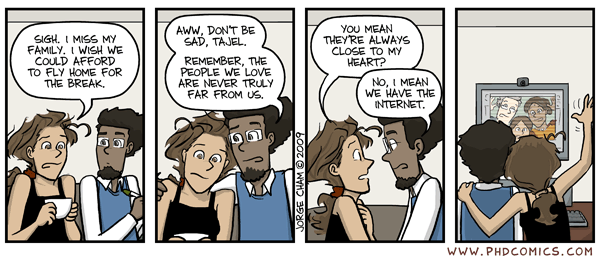


 Posts
Posts


